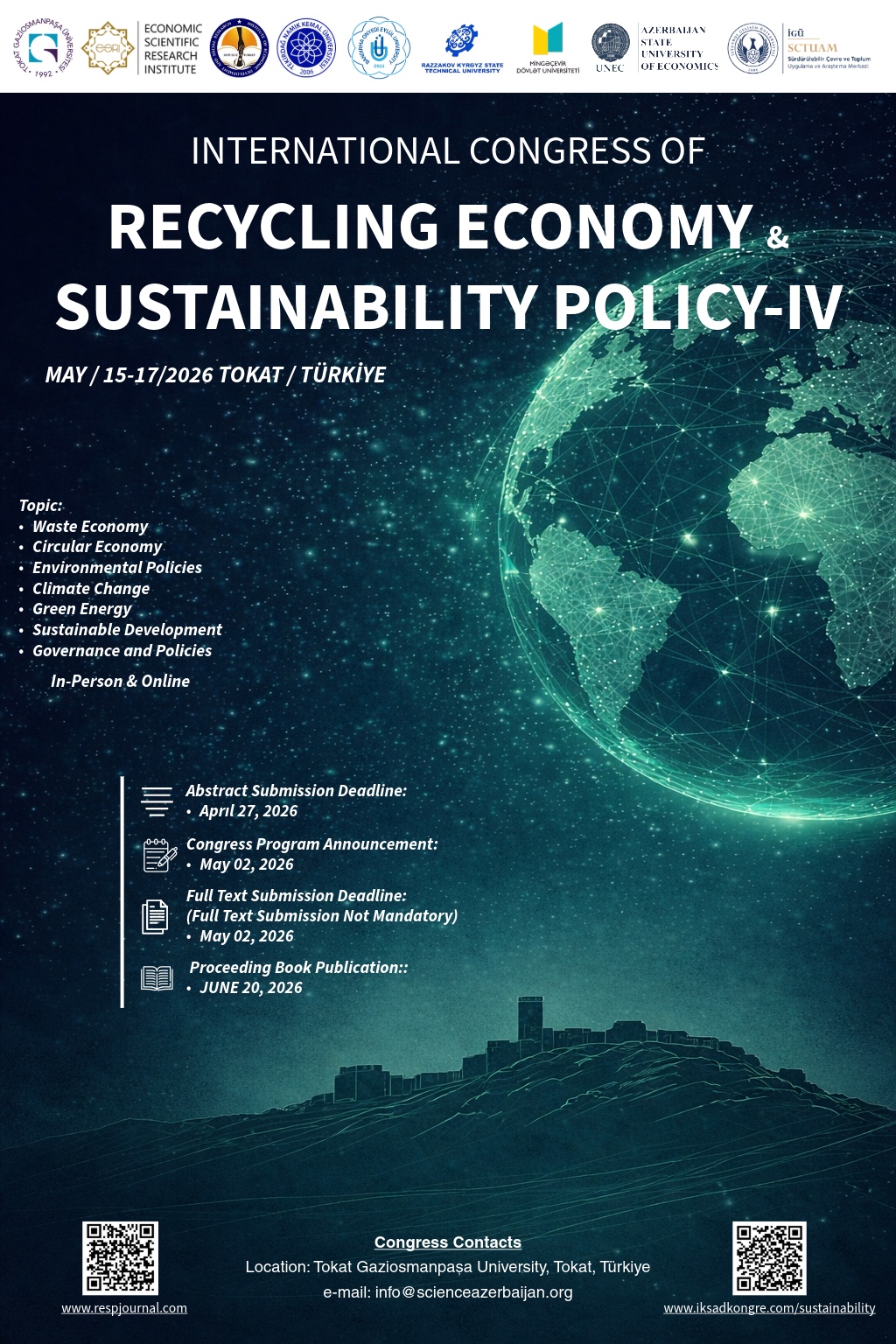
Challenges and Opportunities in Lebanon’s Post-War Recovery: A Comparative Analysis with Iraq
Keywords:
Post-war Recovery, Sustainable Economic Development, Infrastructure Reconstruction, Environmental Sustainability, Governance and Transparency, Poverty AlleviationAbstract
This paper examines the importance of Lebanon adopting a recovery program and collaborating with international institutions following the 2024 war to achieve economic sustainability. Drawing on the successful experience of Iraq in 2003, it explores whether Lebanon can rebuild sustainably. The paper also highlights the key successes and obstacles Iraq faced in implementing its recovery programs. It emphasizes the challenges Lebanon faces related to governance, institutional capacity, and political fragmentation, and advocates for coordinated international cooperation, capacity-building, and anti-corruption efforts. The findings stress the need for tailored and inclusive strategies to ensure Lebanon’s long-term economic resilience and social stability.
References
Barbier, E. B. (2013). A new blueprint for a green economy. New York, NY: Routledge. https://doi.org/10.4324/9780203097298
BLOMINVEST Bank. (2019). A Historical Analysis of Lebanon's Public Debt. https://blog.blominvestbank.com/wp-content/uploads/2019/05/A-Historical-Analysis-of-Lebanon%E2%80%99s-Public-Debt.pdf
Bouvier, P. (2012). Humanitarian care and small things in dehumanised places. International Review of the Red Cross, 94(888), 1537-1550. https://doi.org/10.1017/S1816383113000325
Cairns, J. (2003). War and sustainability. International Journal of Sustainable Development & World Ecology, 10(3), 185–193. https://doi.org/10.1080/13504500309469797
CEIC Data. (2025). Lebanon Government Debt: % of GDP, 1998 – 2023. Retrieved October 22, 2025, from https://www.ceicdata.com/en/indicator/lebanon/government-debt--of-nominal-gdp
Center for Strategic and International Studies (2017). Stabilization in Syria: Lessons from Afghanistan and Iraq. CSIS. Retrieved from https://www.csis.org/analysis/stabilization-syria-lessons-afghanistan-and-iraq
Collier, P., Elliott, V. L., Hegre, H., Hoeffler, A., Reynal-Querol, M., & Sambanis, N. (2003). Breaking the conflict trap: Civil war and development policy. Washington, DC: World Bank and Oxford University Press. Retrieved from https://hdl.handle.net/10986/13938
Collier, P., Hoeffler, A., & Söderbom, M. (2008). Post-Conflict Risks. Journal of Peace Research, 45, 461 - 478. https://doi.org/10.1177/0022343308091356.
Economic Research Forum. (2020). Conflict, Institutions and The Iraqi Economy, 2003- 2018. https://erf.org.eg/app/uploads/2020/08/1598521034_905_1381004_1387.pdf
European Institute of the Mediterranean. (2017). Post-conflict re-construction in MENA: Previous experiences and stakeholders' inclusive involvement in the future reconstruction of Libya, Syria, and Iraq. IEMED. https://doi.org/10.1016/j.ppees.2015.06.001
Georgetown Journal of International Affairs. (2023). The End Game to Lebanon's Woes: IMF Reform And Political Willingness. https://gjia.georgetown.edu/2023/11/10/the-end-game-to-lebanons-woes-imf-reform-and-political-willingness/
Hassoun, A. (2025). Sustainability amid conflict: Gaza's environmental, social, and economic struggles. Journal of environmental management, 376, 124433. https://doi.org/10.1016/j.jenvman.2025.124433.
Italian Institute for International Political Studies. (2020). Syria and Iraq: Will post-war reconstruction serve water needs? ISPI. Retrieved from https://www.ispionline.it/en/publication/syria-and-iraq-will-post-war-reconstruction-serve-water-needs-25176
Jundi, S. (2024). The Impact Armed Conflict on Economic Growth and Sustainability in South Sudan. Journal of Developing Country Studies. https://doi.org/10.47604/jdcs.2826.
Manpaa, A., Liberty, F., & Abdullahi, M. (2024). Attaining Sustainable Development in Post-Conflict Societies: A Conceptual and Theoretical Perspective from North-East Nigeria. Global Journal of Political Science and Administration. https://doi.org/10.37745/gjpsa.2013/vol12n15672.
Matsunaga, H. (2019). The reconstruction of Iraq after 2003: Learning from its successes and failures (MENA Development Report). World Bank Publications
Mohammed, H. A., & Bakar, A. S. A. (2025). Economic consequences of the US invasion of Iraq: A comparative study using the difference-in-difference model. Multidisciplinary Science Journal, 8(2), 2026189. https://doi.org/10.31893/multiscience.2026189
Nguyen, T. T., Grote, U., Neubacher, F., Rahut, D. B., Do, M. H., & Paudel, G. P. (2023). Security risks from climate change and environmental degradation: Implications for sustainable land use transformation in the Global South. Current Opinion in Environmental Sustainability, 63, 101322. https://doi.org/10.1016/j.cosust.2023.101322
Serneels, P., & Verpoorten, M. (2015). The Impact of Armed Conflict on Economic Performance. Journal of Conflict Resolution, 59, 555 - 592. https://doi.org/10.1177/0022002713515409.
Suarez, A., Arias-Arévalo, P., & Martinez-Mera, E. (2018). Environmental sustainability in post-conflict countries: Insights for rural Colombia. Environment, Development and Sustainability, 20(3), 997–1015. https://doi.org/10.1007/s10668-017-9925-9
Trading Economics. (2025). Iraq Foreign Exchange Reserves. Retrieved October 22, 2025, from https://tradingeconomics.com/iraq/foreign-exchange-reserves
Trading Economics. (2025). Lebanon Inflation Rate. Retrieved October 22, 2025, from https://tradingeconomics.com/lebanon/inflation-cpi
United States Institute of Peace. (2005). Post-conflict stabilization and reconstruction: What have we learned from Iraq and Afghanistan? Retrieved from https://www.usip.org/publications/2005/04/post-conflict-stabilization-and-reconstruction-what-have-we-learned-iraq-and
Unruh, J., & Williams, R. (Eds.). (2013). Land and post-conflict peacebuilding. Routledge. https://doi.org/10.4324/9781849775793
World Bank. (2021). Lebanon Economic Monitor: The great denial (Fall 2021).
World Bank. (2024). Iraq Overview: Development news, research, data. https://www.worldbank.org/en/country/iraq/overview
World Bank. (2025). Lebanon's Recovery and Reconstruction Needs Estimated at US$11 Billion. https://www.worldbank.org/en/news/press-release/2025/03/07/lebanon-s-recovery-and-reconstruction-needs-estimated-at-us-11-billion
Downloads
Published
How to Cite
Issue
Section
License
Copyright (c) 2025 Journal of Recycling Economy & Sustainability Policy

This work is licensed under a Creative Commons Attribution 4.0 International License.